Case studies Interview Query, 6 min read
Rebuilding a Founder's YouTube Channel Around Buyer Intent
Role. Content Marketing Manager for CEO Jay Feng's YouTube channel. Owned strategy, topic selection, research, thumbnails, and attribution. Managed a team of contract writers and video editors, and wrote the technical scripts myself.
- 2M+
- views
- 42K → 57K
- subscribers
- 3–5% → 5–10%
- thumbnail CTR
Context
YouTube was the highest-intent channel Interview Query had. People searching for "what is a data scientist interview like" are not browsing, they are preparing, and preparing is one step away from paying.
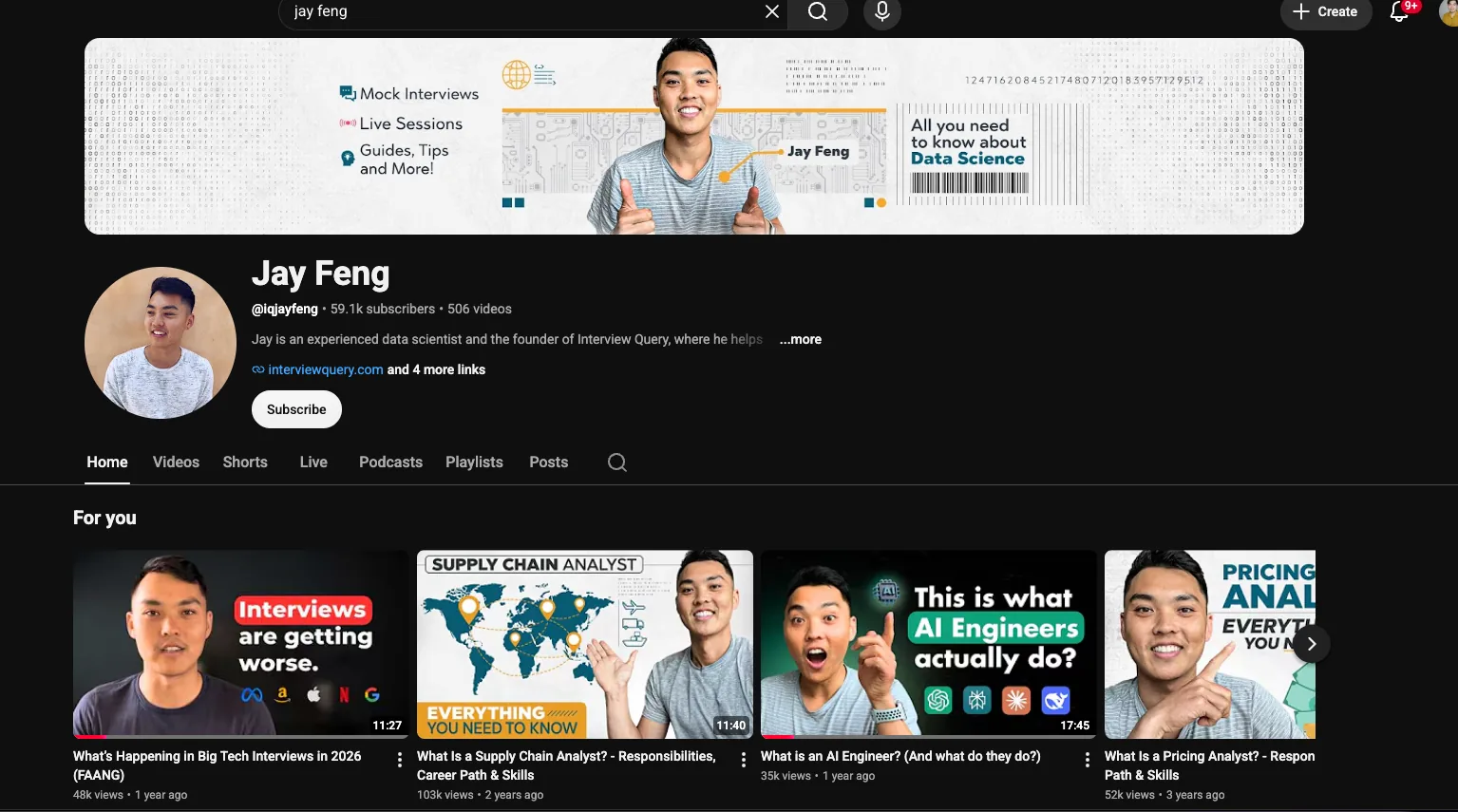
The channel already existed and already worked in the ordinary sense. Jay had built a real library, mock interview videos were the signature format, and the audience was there at ~42,000 subscribers.
Three things were wrong underneath that:
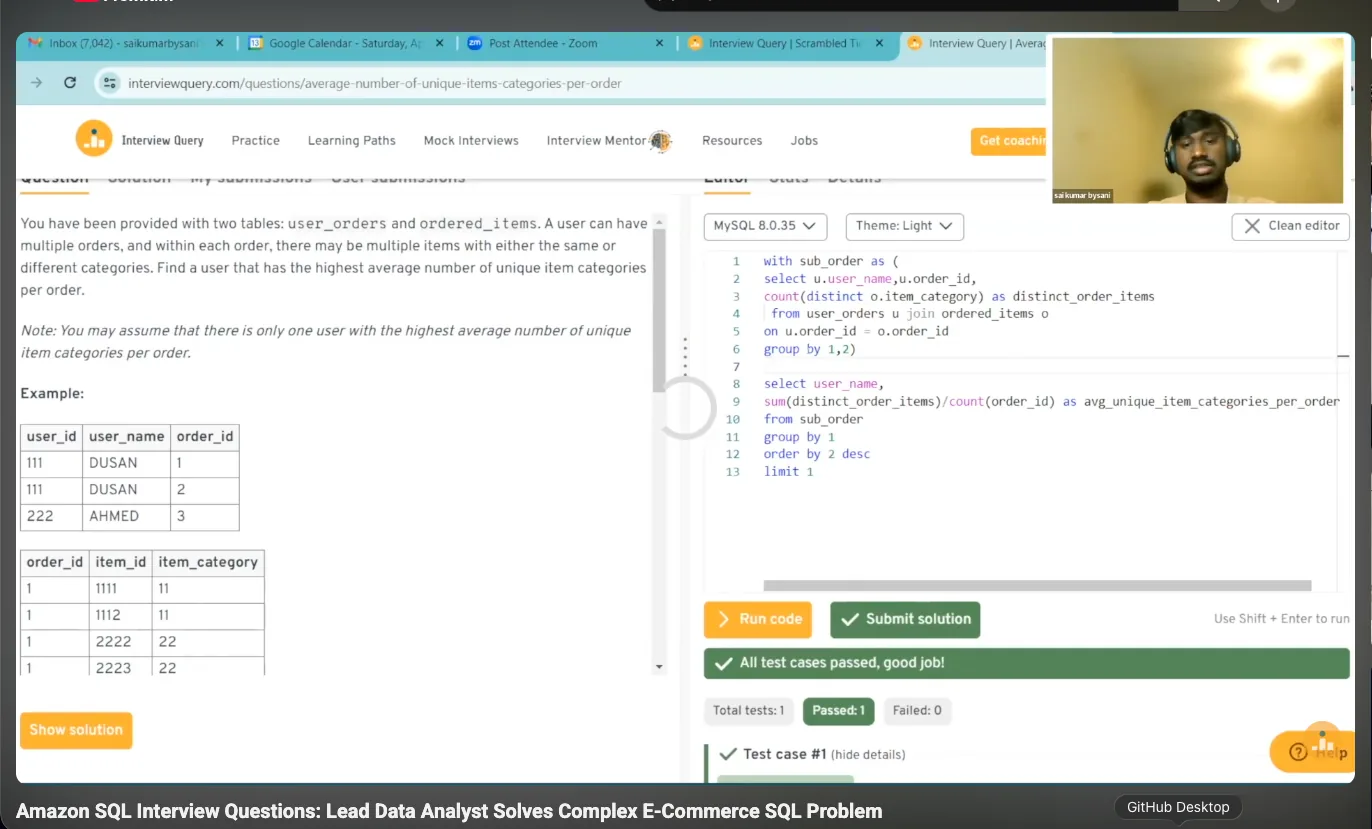
The product was invisible. Mock interviews were filmed on Interview Query's own platform, and viewers could not tell. They watched a candidate solve problems in a tool, and no one ever said what the tool was. We were running product demos that nobody recognized as product demos.
Production was outsourced and expensive. An external agency produced the mock interviews at 2 to 3 times what it cost us to run in-house, which capped how often we could publish.
Nothing connected video to the rest of the funnel. The SEO system was built on company interview guides. The channel was not feeding them.
Insight: The Channel Did Not Need New Content
The instinct when a channel plateaus is to invent a new format. That was not the problem here.
The problem was that content which already held attention was pointed at nothing. Fixing the path from video to product was worth more than any new idea, and it was faster.
Key realization: Views are not the asset. The asset is what the viewer can do next, and most channels never build it.
Strategy, Act 1: Make the Existing Format Actually Sell
1. Put the product on screen, by name
We rebuilt the mock interview format so the tool was visible and named. Same video, same value, same guest quality. The difference was that a viewer finished it knowing where the interview questions came from and where to go practice them.
2. Bring production in-house
We replaced the external agency with our own pipeline: mock interviews recorded over Zoom, other videos shot by Jay, editing handled by our own editors. That cut cost 2 to 3x and, more importantly, made cadence predictable. Roughly one to two weeks per video, consistently, instead of whatever the agency could fit in.
3. Partner for reach and credibility
We brought in creators in the space, including Venkata Sai, to appear in the format. Their audiences were exactly ours, and a guest interviewing on our platform is a stronger endorsement than any claim we could make about it ourselves.
4. Division of labor
I ran strategy, topics, research, thumbnails, and attribution, and wrote the technically demanding scripts myself. Contract writers handled the rest under my briefs, editors handled post. Jay's involvement was deliberately narrow: he checked scripts for factual and technical accuracy. He is the credibility, so his time went where credibility is actually at risk.
When the Format Started to Fade
Two forces hit at once. Audience fatigue with mock interviews, and a broader shift in how people were watching, away from long-form and toward short.
We caught it early, and we did not kill the format. We transitioned out of it gradually so the change did not read as abrupt to the audience. A channel that visibly abandons its signature format teaches viewers they cannot predict what they are subscribed to.
Strategy, Act 2: Two Formats That Replaced It
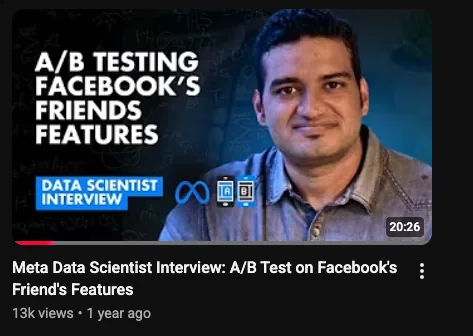
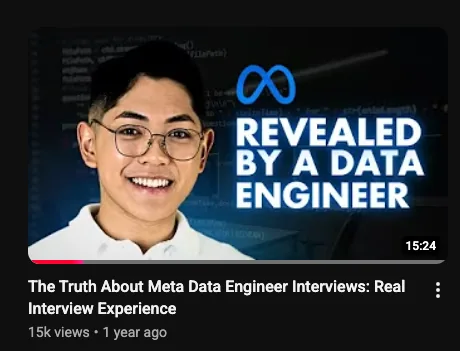
1. "The truth about an X company interview"
A direct answer to the question the audience was already asking, and a direct match to the company interview guides that drove revenue on the SEO side. The video created the curiosity, the guide answered it, the product converted it. This was the first format that made YouTube a genuine funnel entry point instead of a brand channel.
2. Job market research and commentary
We moved into the state of the job market: hiring conditions, what was happening inside big tech, what roles were actually being filled. This pulled thousands more views per video than anything before it.
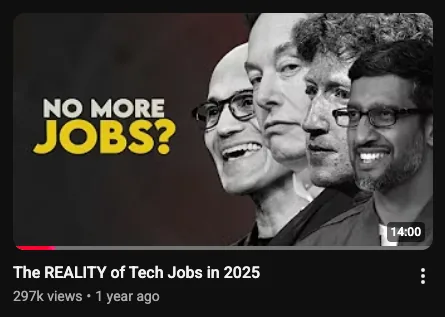
The peak was 297,000 views on a single video about the reality of tech jobs, published on New Year's Day. The timing was planned, not lucky. That is the week the entire audience is thinking about whether to change jobs.
Distribution and Packaging
Thumbnails and titles. I ran thumbnail testing as an ongoing system rather than a one-time cleanup, and took the channel from a 3 to 5% CTR to 5 to 10%. The working formula was a genuine reaction from Jay, three to five words with a colored highlight, recognizable company logos as anchors, and thumbnail text that pulls against the title rather than repeating it. A title of "What's Happening in Big Tech Interviews in 2026" over a thumbnail reading "Interviews are getting worse" gives the viewer two reasons to click instead of one.
Shorts. Rather than produce short-form separately, I built a repurposing system using Opus Clip to cut long-form videos into Shorts. It added roughly a thousand views a day at close to zero marginal production cost.
Conversion
Video traffic converted through description links and, notably, through people arriving at the site directly and self-reporting YouTube as the reason they came. That second path is invisible in analytics, which is exactly why channels like this get under-credited internally.
YouTube ended as roughly 10% of attributable revenue contribution, behind SEO and ahead of nothing else by much, and it carried the highest purchase intent of any channel we ran.
The channel was also AdSense monetized and produced about $5,000 in ad revenue during my tenure. That was never the point. It covered costs while the channel did its real job.
Results
-
2M+ views across the videos produced during my tenure
-
42,000 → 57,000 subscribers (59.1K today)
-
53 videos produced, averaging roughly 38,000 views each
-
Top video: 297,000 views, timed to a New Year's Day release
-
Thumbnail CTR: 3–5% → 5–10%
-
Production cost cut 2–3x by moving from an external agency to an in-house pipeline
-
~1,000 extra views per day from repurposed Shorts at near-zero added cost
-
~$5,000 in AdSense revenue, secondary to acquisition
-
Highest-intent channel in the mix, at roughly 10% of attributable revenue
What I Would Do Differently
The mock interview retirement was a managed decline, and I am comfortable with how we handled it. The real failure is elsewhere.
The system was too dependent on me. I was the coordinator holding strategy, topic selection, scripting standards, thumbnails, and editor management in one head, and after I left the team struggled to keep producing at the same rate.
That is not a compliment to how essential I was. It is a design flaw I built. I should have trained a second person to evaluate topics and scripts with the same judgment, and documented the process to the point where the channel could run without the person who designed it.
A content system that only works while you are running it is not a system. It is a dependency.
That lesson now shapes how I set up every channel I take on.
Takeaway
Most channel strategies start by asking what to make next.
What actually worked:
-
Fix the path from existing content to the product before inventing new content
-
Name your product on screen, because viewers will not connect it themselves
-
Bring production in-house when the cost of outsourcing is capping your cadence
-
Retire a fading format gradually, so the audience is never surprised
-
Time your biggest swing to when the audience is already thinking about the problem
-
Build the handover before you need it
At Interview Query, YouTube did not grow because we found a better format.
It grew because we made the formats we already had point somewhere.